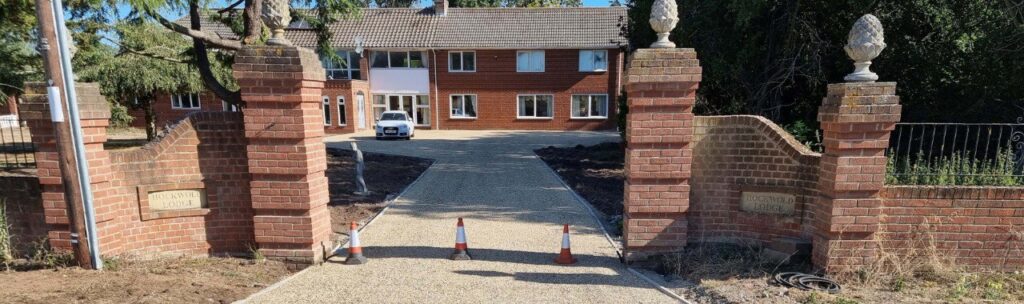
How Can a Well-Planned Driveway Make Better Use of Your Outdoor Space?
A driveway should do more than provide somewhere to park. Its layout affects how easily vehicles can enter and leave, how people move between the road and the property, and how much useful garden space remains.
Careful planning can turn an awkward or underused area into a practical entrance that supports everyday routines. The key is to design the driveway around the property, the available space and the way the household will actually use it.
How Thoughtful Driveway Design Improves an Outdoor Area
It Uses the Available Space Efficiently
Every property has different boundaries, access points and ground levels. A standard rectangular layout may waste space or create unnecessarily narrow areas that are difficult to use.
A site-specific design considers:
- The width and position of the entrance
- Existing walls, fences and planting
- The location of doors and pathways
- Changes in ground level
- The number and size of vehicles
- Where vehicles need to turn
- Drainage routes
- Areas that should remain as garden
Planning around these features helps create a driveway that fits naturally within the available space.
It Makes Parking More Practical
Parking spaces should be positioned so that vehicles can be used without repeatedly moving one another. Doors also need sufficient room to open without striking walls, fences or neighbouring vehicles.
A well-planned driveway may use its width more effectively, provide clearly defined parking positions or improve the angle at which vehicles approach the property. These details can make daily parking considerably easier.
The design should reflect the vehicles normally using the driveway rather than relying only on theoretical dimensions.
It Improves Vehicle Movement
A driveway that is difficult to enter, reverse from or turn around can make a generous outdoor area feel restricted. Poorly positioned borders and abrupt changes in width may further reduce manoeuvring space.
Careful planning can create smoother routes between the entrance and parking areas. On longer or wider driveways, a turning area may help vehicles change direction within the property.
This is particularly useful where the driveway is used frequently or by more than one vehicle.
It Creates Safer, Clearer Pedestrian Routes
People should not have to squeeze between parked vehicles or walk across muddy planting areas to reach the house. A driveway design can incorporate a clear pedestrian route from the entrance to the front door, side gate or garden.
Contrasting paving, defined edging or a separate path can help distinguish walking areas from parking spaces. This improves the organisation of the frontage and makes movement easier when vehicles are present.
It Connects Different Outdoor Areas
A driveway often sits alongside paths, patios, lawns and planted borders. Treating these as completely separate elements can produce awkward gaps and disconnected levels.
Coordinated planning allows the driveway to connect naturally with other parts of the outdoor space. Materials, edging and levels can be selected to create practical transitions without making every surface look identical.
The result is a frontage that feels considered as a whole rather than assembled one section at a time.
It Preserves Useful Garden Space
Creating more parking does not always require surfacing the entire front garden. An efficient layout may provide the required vehicle space while retaining planting beds, lawn or other landscaped areas.
The most useful balance depends on the household’s priorities. Clearly defined borders can prevent vehicles from encroaching on planted areas, while carefully shaped beds can soften the appearance of a larger driveway without restricting movement.
It Allows Drainage to Be Planned Properly
Driveway levels should direct rainwater away from buildings and prevent persistent puddles from forming. Drainage is most effective when it is considered during the design stage rather than added after surfacing.
A professional plan can account for:
- The natural fall of the ground
- Low points where water may collect
- The position of drainage channels
- Connections between different surfaces
- Water flowing from adjoining paths or roofs
- Suitable gradients across parking areas
Managing these factors helps protect the surface and keeps access more usable during wet weather.
It Makes Awkward Boundaries More Manageable
Irregular boundaries, narrow entrances and curved garden edges can make an outdoor area difficult to organise. The right combination of surface materials and edging can turn these limitations into useful design features.
Tarmac can provide a smooth continuous surface around curves, while block paving can define entrances, parking bays or borders. Resin may suit areas where a seamless decorative finish is preferred. The correct option depends on the base, drainage requirements and intended use.
It Can Accommodate Everyday Practicalities
A driveway should work alongside the less visible parts of daily life. Space may be needed for bins, bicycles, garden access or deliveries without obstructing parked vehicles.
Considering these requirements early can prevent a new driveway from creating bottlenecks. Discreet storage areas and clear side access can be incorporated into the overall layout rather than treated as afterthoughts.
It Can Support Future Needs
Household requirements can change. An additional vehicle, different access needs or a new garden layout may place different demands on the frontage.
Although every future change cannot be predicted, sensible proportions and flexible parking arrangements can make adaptation easier. A well-planned driveway avoids unnecessary fixed obstacles and uses durable edges to maintain a clear structure.
Why Professional Planning Matters
The appearance of a driveway is important, but its long-term value depends on how well the layout, ground preparation, drainage and surface work together.
At Cambourne Driveways, we assess how the outdoor space is currently used before recommending a layout. This enables the driveway to be designed around practical access, vehicle movement and the features the property owner wishes to retain.
Conclusion
A well-planned driveway can improve parking, create clearer pedestrian access and connect different parts of an outdoor area. It can also preserve garden space, address awkward boundaries and incorporate effective drainage from the outset.
If you are considering a new or redesigned driveway for your property in Cambourne, Cambridgeshire, contact Cambourne Driveways to arrange an assessment and discuss a layout suited to your outdoor space.
Call us on: 01954 774 563
Click here to find out more about Cambourne Driveways
Click here to complete our contact form and see how we can help with your driveway needs.